Solutions
Skilling
AI-Native Solutions
Managed Services
Learning Content
Products
BrinX
AI Scenario Builder
Industries We Serve
Learning for Key Sectors
Airlines
Banking & Finance
Oil & Gas
Pharma & Healthcare
Retail
Telecom & IT
Business Areas
Global Capability Centers
Our Work
Insights
Who We Are
About Upside Learning
Leadership
Awards
Press Releases
Clients
Careers
Contact Us
Talk to Us

Measuring Training Impact Through Learning Effectiveness Metrics

L&D functioned for very long as a support team within organizations

L&D functioned for very long as a support team within organizations, with training of any sort being treated largely as a learning delivery mechanism for employee orientation.

However, more and more organizations are now beginning to focus on how learning initiatives can align to their business goals, and impact employee performance directly. That makes L&D a direct stakeholder in impacting businesses overall – something our entire fraternity wanted for the longest time. The question then is – are we equipped to play the part?

While learning delivery has continually evolved – keeping up with new technology and innovating on effective learning design – the measurement of the value brought in by these initiatives has largely remained a challenge.

Currently, most organizations are relying on course completion (or even learner satisfaction aka smile sheets) data as their only indicator for measuring learning effectiveness. By itself, this is insufficient and often misleading. It’s a good indicator only if it’s used as a basis for deeper analysis on how to improve the effectiveness of learning interventions.

Though organizations realize the value of more robust analytics, they often have trouble identifying the right metrics to measure the impact of their learning interventions.

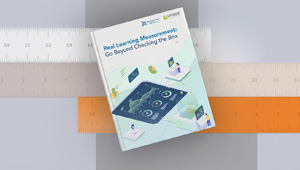
Since our GoBeyond initiative has been about nudging L&D to go beyond ‘ticking the box’ and focus on what matters most, Measuring Learning Effectiveness seemed like an area that could use some of our undivided focus.


Frequently Asked Questions

It is the process of figuring out whether a learning program is producing the intended outcomes, such as improved job performance, altered behavior, knowledge retention, and alignment with business KPIs.
Without measurement, L&D becomes a cost center. Measuring outcomes helps prove ROI, optimize future training investments, and demonstrate how learning drives business performance.
We use frameworks like Kirkpatrick's Four Levels, Phillips ROI Model, and our own performance-based evaluation models to track outcomes from reaction to business impact.
Yes. We design SCORM- or xAPI-based modules that integrate with your LMS, LXP, or learning record store (LRS) to track progress, scores, and behavioral outcomes.
We start by aligning training goals with KPIs, and then we use a combination of surveys, assessments, management feedback, and system data (such sales, compliance, and productivity) to track real effectiveness.
Completion rates, evaluation results, engagement metrics, application-level feedback, time-to-competency, performance on the job, and ROI indicators are a few examples of data.
Yes. We offer measurement frameworks and post-training analysis tools (surveys, assessments, 360 feedback, dashboards) even for non-digital or past programs.
Our dashboards and insights are designed not just to report outcomes but to inform future design, identify learning gaps, and recommend content or strategy changes.
Challenges include lack of defined metrics, disconnected systems, limited follow-up, and difficulty tying behavior change to business outcomes. We help you overcome these with structured frameworks.
Go Beyond is about impact—not just completion. Our measurement services ensure that every learning initiative is evaluated, optimized, and aligned to strategic business outcomes.

Looking to Measure your Learning Outcomes?